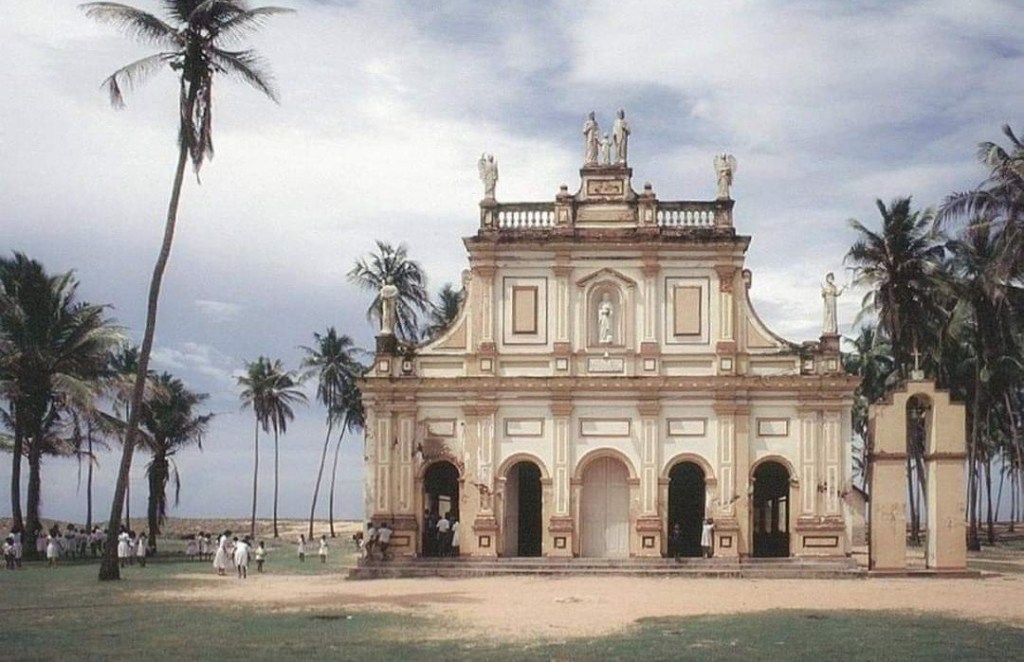
Introduction: Church of St. Mary Magdalene, Dungalpitiya
Nestled along the tranquil coastal belt of Negombo, the Church of St. Mary Magdalene in Dungalpitiya stands as a cherished beacon of faith, tradition, and community. With its humble origins tracing back over a century, this sacred sanctuary has become an integral part of the spiritual and cultural identity of the village. Beyond its architectural grace and serene surroundings, the church reflects the deep-rooted devotion of generations who have gathered here in prayer, celebration, and service. This blog post takes you on a journey through the history, significance, and enduring legacy of the Church of St. Mary Magdalene—a place where faith meets heritage, and where the spirit of a community continues to thrive.
Page – 01
St. Mary Magdalene’s Church, Dungalpitiya: the Magdala of Ceylon
1. On the twenty second of July of every year our hearts warm up to turn towards our mother – the mother of our village – the Church dedicated to St. Mary of Magdala.
2. Since 1919, this unique and magnificent Church, despite all winds and waves, has been standing between the Sea and the Lagoon shaping, the landscape of our village into a modern-day Mesopotamia. The ancient Mesopotamia was situated between the waters, the Euphrates and the Tigris.
3. The Church is, aptly, dedicated to St. Mary of Magdala. Magdala, modern Mejdel, is found along the western coast of the Sea of Galilee. It thrived in the ancient times as a fishing village. All these traits match proportionately the demography of the Ceylonese hamlet by the west coast.
4. Above all, Mary remained, in the days of Jesus, an icon of fidelity. She is, in the Gospel narrations, the key figure as a witness to the crucifixion, death, burial and Resurrection of the Lord. She was ‘the apostle to the apostles’ (‘apostolorum apostola’), in the words of the Angelic Doctor, St. Thomas Aquinas (in Ioannem Evangelistam Expositio, c. XX, L. III, 6), sharing the good news of Jesus’ Resurrection with the male disciples, who, in turn, did announce it to the whole world.
Similarly, Dungalpitiya, the Pearl and Pride of Maha Pamunugama, remains a Citadel of Catholic Faith in the maritime provinces of the Pearl of the Orient. The Sunday Mass we participated in, either inside the tiled Church, or mostly in the cool sea-breeze under the natural palm-branched canopies of the coconut groves, made our faith unflinching.
Magdala is derived from the Hebrew Migdal ( מִגְדָּל ), meaning fortress or tower. A towering faith or a fortified fidelity is inherited by everyone living by the sea or the lagoon, though we do not find here remnants of any ancient tower or fortress.
Thus, the villagers could legitimately be called ‘the Ceylonese descendants of St. Mary Magdalene’, whilst their village, surrounded by pristine nature, could rightly be honoured as ‘the Ceylonese Magdala of the biblical Magdala.’
5. How did the villagers develop in this hallowed place a devotion to the Saint? This is a historical question, which requires an unequivocal answer.
According to Saviour Shanthalal Hettiarachchi, a prolific and versatile writer of the parish, an old statue was washed ashore. It had been thrown from a Portuguese ship, with a note reading, ‘Whoever finds this Statue of Mary Magdalene should build a Church in her honour.’
Thus came a so-called ‘sinner’ (i.e. erroneous theology due to uncritical reading of the Gospels) to the midst of ‘saints’ like St. Mary (of Pitipana and Uswetakeiyawa), St. Anthony (of Kepungoda), St. Nicholas (of Bopitiya) and St. Joseph (of Pamunugama).
6. The feast of this Saint, who came to us from the nearby sea and originally from the Sea of Galilee, would definitely evoke, to add a personal note herein, our golden memories of the halcyon days we lived in the village blessed with breathtaking natural beauty and lush greenery.
Just like the sea waves drift to the shore, the fond memories treasured, of our matriarchs and patriarchs, would gush out to our minds. “The memory of the righteous is for a blessing”, say the sages of Israel in Proverbs 10,7. Of revered and blessed memory are the righteous of my maternal ancestry: John Esidore Wanasinghe, my great-grandfather (seen only on photo), Mary Gertrude Ranasinghe (15 August 1908 – 16 November 1995), my great-grandmother, Mary Margerette Susila Wanasinghe, my grandmother, and Joseph Gerard Wijesuriya, my grandfather.
We may also recall how we learnt, in the 1970s, the ABC of Catechism, in a serene and peaceful environment, under the coconut groves of the Church garden, and were educated in the nearby community centre (‘Praja Mandalaya’), and the state school flanking the Church.
7. Later in life, we learnt that it was in this Church that we were baptized. It was the Lord’s Day, 3rd October 1971. In front of the Minister, Rev. Fr. Luigi Hettiarachchi, my Godparents: Hettiarachchige Don Wilfred and Dona Chandra Kanthi Wijesuriya, my parents: Hettiarachchige Don Cyril and Dona Mary Chandralatha Wijesuriya and my maternal grandmother, Mary Margerette Susila Wanasinghe, I was proclaimed to be a child of God. The portals of the Church were thus opened for me to walk gracefully to the Altar one day to be a priest of God.
Let me conclude this vignette on the socio-religious life of a people by the sea with the sentiments expressed by the renowned writer, J. Vijayatunga, in his classic, ‘Grass for my Feet’ (London, 1935):
Languid afternoon on a tropical sea
Within view of the palm-fringed coast
Dusky half-clad men seeking nothing –
Ah, drift me from here to that country!
Liquid sunshine pattering on broad leaves
Sleepy squirrels and over-fed chameleons
Black-skinned boy gliding down a palm –
Oh, for the sun-skimmed lagoons!
E-Current Comments:
Fr. Don Anton Saman Hettiarachchi
Internet Media Ministry
St. Anthony’s Bible Academy (SABA)
22 July 2025
Page -02
TRACTS FOR THE TIMES
Tract 03: Mary of Magdala: the Sinner?
Dedicated with ‘guru bhakthiya’ to:
Rev. Fr. James Dudley Perera OMI,
Inspiration of my life-long enthusiasm in the Sacred Scriptures,
and Professor of New Testament Studies, National Seminary of Our Lady of Lanka, Ampitiya, Kandy
Claim:
1. On the twenty second of July, we celebrate the Feast of St. Mary of Magdala. It is also the holy day on which we often hear some unholy claims, such as:
i. Mary of Magdala was a sinner first, a sex worker in particular.
ii. She then encountered the Lord and washed His feet.
iii. Thus the repentant sinner became a saintly disciple of the Lord.
2. These statements lead us to an in-depth study of the biblical character and thus, unfolds the tract, ‘Mary of Magdala: the Sinner?’
Text:
3. Let us scrutinize the Scriptures and so, read Luke 8,1-3:
“Afterward he journeyed from one town and village to another, preaching and proclaiming the good news of the kingdom of God. Accompanying him were the Twelve and some women who had been cured of evil spirits and infirmities, Mary, called Magdalene, from whom seven demons had gone out, Joanna, the wife of Herod’s steward Chuza, Susanna, and many others who provided for them out of their resources.”
What the Text says:
4. According to the aforementioned Text, Mary was once possessed, inhabited by devils, bringing in its train mental problems, emotional disturbances, physical illness and social marginalization.
5. Far worse, Mary was possessed by “seven” of them – biblically meaning completion. So she was overwhelmingly possessed, severely demonized, wholly in the grip of the evil forces, seriously ill and thus living at the margins of society. It was then that Jesus cured her, freed her totally and welcomed her as a disciple (cf. Mark 16,9; Luke 8,2).
6. What a powerful and compassionate exorcist Jesus had been then!
What the Text says not:
7. Mary is thus pictured as once ‘possessed’ and not ‘sinful’. In the Gospels, possession is not synonymous with sinfulness. The sinners – tax collectors, non observants of the Law of Moses, prostitutes – are clearly distinguished from those possessed. Thus she is possessed, but not sinful.
Myth of Mary:
8. Then what is this talk about Mary as a sinful woman who anointed the feet of Jesus? It comes from the later Western romantic tradition.
9. What we see in the Gospels is Jesus being anointed:
i. in the house of Simon the leper in Bethany by a woman unknown (Mark 14,3; Matthew 26,7);
ii. in the house of Simon a Pharisee by a woman known in the town to be a sinner (Luke 7,37); and,
iii. in Bethany by Mary the sister of Lazarus and Martha (John 12,3).
Conclusion:
10. The Gospels are full of Marys; Mary Magdalene went to anoint Jesus’ dead Body and so later confusion is always possible!
Tracts for the Times:
Motto: “Ex umbris et imaginibus in veritatem”
‘Out of shadows and images into truth’
Epitaph of St. John Henry Newman
Previous Tracts:
Tract I: Is the Name of God Jehovah?
Tract II: Did Saul become Paul?
Tracts for the Times:
Fr. Don Anton Saman Hettiarachchi
Internet Media Ministry
St. Anthony’s Bible Academy (SABA)
22 July 2025
 Foundation for Lasting Relationship